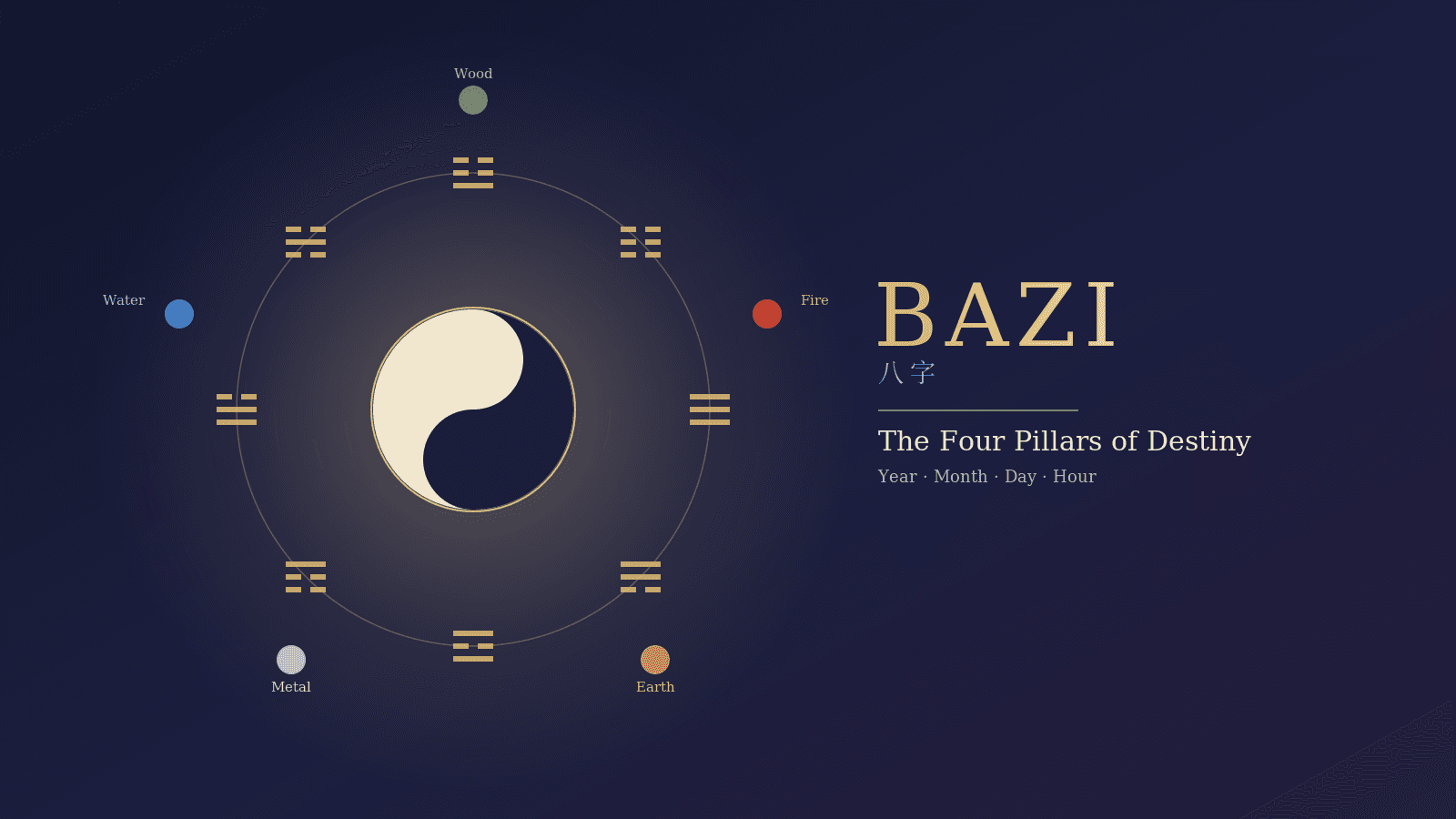
Bazi (八字), literally "eight characters," is a form of Chinese astrology also known as the Four Pillars of Destiny. It maps the energies present at the moment of your birth into a chart believed to reflect your personality, relationships, health, and life trajectory. Unlike Western astrology, which centers on star signs, Bazi is built entirely on the Chinese lunar calendar and the interplay of Yin-Yang and the Five Elements.
The Four Pillars
A Bazi chart is built from four pairs of characters, drawn from your birth year, month, day, and hour:
- Year Pillar – linked to ancestry, childhood, and public image
- Month Pillar – linked to career, parents, and social environment
- Day Pillar – considered the core of the chart; the Day Stem represents you, the self
- Hour Pillar – linked to children, later life, and inner desires
Each pillar is made of two characters: a Heavenly Stem and an Earthly Branch. There are 10 Heavenly Stems and 12 Earthly Branches, and together they cycle through a 60-year combination — the same system used to name years in the Chinese zodiac (Year of the Dragon, Snake, and so on).
Yin-Yang and the Five Elements
Every stem and branch carries an element — Wood, Fire, Earth, Metal, or Water — and a polarity, Yin or Yang. These elements interact through two core cycles:
- Generating cycle: Wood feeds Fire, Fire creates Earth (ash), Earth bears Metal, Metal enriches Water, Water nourishes Wood.
- Controlling cycle: Wood parts Earth, Earth absorbs Water, Water extinguishes Fire, Fire melts Metal, Metal cuts Wood.
A Bazi reading looks at which elements dominate a chart, which are missing, and how they support or clash with one another. The goal is usually to find balance — an over-concentration of one element (say, too much Fire) is thought to create excess in certain areas of life, while a missing element points to a gap that may need to be compensated for.
How a Reading Works
A practitioner typically starts by converting your birth date and time into the correct stems and branches, since the Chinese calendar doesn't map neatly onto the Gregorian one. From there, they identify your Day Master (the element of your Day Stem) — this becomes the lens for interpreting everything else in the chart. Other elements are read in relation to the Day Master: as resources, as output, as wealth, as influence, or as challenge.
Many readings also incorporate Da Yun, or "Luck Pillars" — 10-year cycles that shift the elemental balance of the chart over a lifetime, layering on top of the fixed Four Pillars to explain why certain periods feel more favorable than others.
What Bazi Is Used For
People commonly turn to Bazi for insight into career direction, compatibility in relationships, timing for major decisions, and general self-understanding. It's also used alongside Feng Shui, since a person's elemental balance can inform which environments, colors, or directions are considered supportive for them.
A Few Misconceptions
Bazi isn't fortune-telling in the sense of predicting fixed events — most practitioners describe it as a map of tendencies and cycles rather than a script. It also isn't the same as the Chinese zodiac you see on placemats; the animal sign is only one small piece (the Year Branch) of a much larger chart. And precision matters: because Bazi is time-sensitive, an accurate birth time is important, and charts are usually adjusted for time zone and local solar time.
Getting Started
If you want to explore your own chart, you'll need your birth date, exact time, and location. From there, a Bazi calculator or practitioner can generate your Four Pillars and walk you through your Day Master, dominant elements, and current Luck Pillar — the foundation for any deeper Bazi study.